 PARKLAB
Reverse Around a Corner
Reverse through a walled 90° bend. Track the inside rear wheel and the front swinging outward.
Observe, then move.
Stop to observe before reversing around the bend. Steer gradually, keep the inside rear wheel clear of the wall and check the outside front corner. Straighten for the exit lane and finish stopped in Park.
What to observe
Alternate the inside mirror with direct observation of the outside front corner. The front swings opposite to the reversing rear; mirror clearance alone does not prove the bumper will pass.
In Physical driving, secure your stopped finish with P and the parking brake. Use Shift+B or the Parking brake button in Options.
Understand reversing around a corner
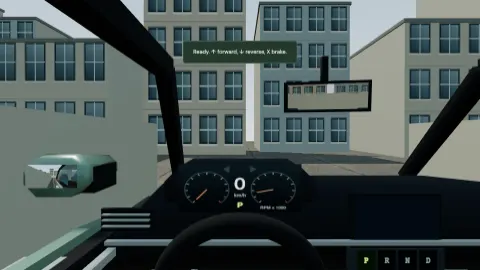
In this ParkLab exercise, a generic car reverses through a 90-degree bend between stationary walls. Compare the rear-wheel path with the front swing, then review the movement from several views. The exercise and its demonstration require Full Access.
Read the bend before moving
Look at the starting lane, the inside wall and the exit lane from Geometry. The gap beside the rear wheel is only one part of the space the whole car needs. Compare the car body, mirrors and front overhang with both walls. Begin at a comfortable difficulty and watch the demonstration before trying the same layout yourself.
Observe the rear path and front swing
During a reversing turn, the inside rear wheel follows a different arc from the front corner. A clear rear-wheel path does not prove that the body or mirror is clear. Pause the demonstration as the car turns and inspect both ends from above. Then compare the same moment in Cockpit and the mirrors to see what each view reveals or hides.
Practice, stop and review
In the simulation, reverse slowly while observing both sides. Stop before clearance becomes uncertain, then decide whether a correction is needed. Straighten for the exit and finish stopped in Park. Use the replay to identify when a corner approached a wall, and change one part of the approach on the next attempt. Smaller movements are useful only when they actually create room.
Know the limits of the simulation
This walled bend is not a road junction or a driving-test route. ParkLab does not simulate pedestrians, moving traffic or a measured real car, and its reference points are not universal. Real reversing requires observation around the vehicle, including blind spots, and suitable instruction. The rules depend on where you drive; consult the local highway code and a qualified instructor.
Further reading: Highway Code rules on reversing (UK).
Related practice: Three-Point Turn · Tight Garage Entrance · Reverse Bay Parking.
Read the mirror and reference-point guide or practice corrections in tight spaces.
Exercise notes by the ParkLab team · Reviewed . ParkLab is a generic simulated vehicle, not a driving certification.