 PARKLAB
Reverse Bay Parking
Reverse from the aisle, turn between neighboring cars, and finish inside the lines.
Observe, then move.
Begin across the aisle, observe both sides, then reverse slowly toward the bay. Leave room for the front swing. Brake and make a forward correction if the aisle is tight; straighten when both bay lines run parallel in your mirrors.
What to observe
Compare the two bay lines in your side mirrors. Unequal spacing means lateral offset, even when the car looks straight.
In Physical driving, secure your stopped finish with P and the parking brake. Use Shift+B or the Parking brake button in Options.
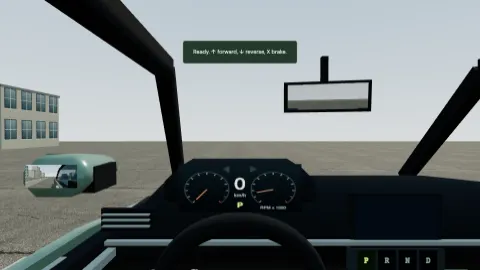
Reverse parking practice in a marked bay
Reverse into a perpendicular parking bay and learn how the rear-wheel path differs from the front-corner swing. The free exercise includes neighboring cars, marked lines, mirrors and a demonstration you can inspect from six views.
Read the bay and the aisle
Two painted lines define the target, but the neighboring vehicles and aisle also determine whether your approach works. Start on Beginner and look at the available room across the aisle. In Geometry, identify the rear axle, front corners and mirrors of the white player car. Notice that steering rotates the whole body around a curved path: the front does not follow the same track as the rear. A final position between the lines can be reachable from one approach and awkward from another.
How to practice reversing into the space
Watch the demonstration and pause as the car starts steering toward the bay. Return to Cockpit, observe both sides and reverse at a controlled speed. Aim to bring the car toward the bay’s direction without cutting a rear corner into the neighboring vehicle. As the body approaches parallel alignment with the lines, straighten progressively. Stop if the approach is too narrow or the angle is increasing in the wrong direction. A forward correction can create a better starting angle; it is part of managing the available space, rather than proof that the whole attempt is lost.
Use both bay lines as observations
Compare the visible line on each side of the car. Similar directions help you judge alignment, but equal-looking gaps in two mirrors do not always mean equal physical distances: the viewpoints differ. Combine the mirrors with the changing picture behind you and a replay from Geometry. Once the steering is straight, check whether the body is aligned as well; straight wheels alone do not make an angled car parallel. Keep enough space behind the bumper to finish the maneuver rather than driving until the rear camera shows no room.
Common reverse bay parking mistakes
Steering too early can take the inside rear corner toward a neighboring car. Steering too late can leave a steep angle that the remaining bay length cannot correct. Watching only the rear camera misses the front swinging toward the opposite side of the aisle. If a contact occurs, inspect the frame just before it and compare the mirror view with the outside view. Identify which physical corner was approaching the obstacle and which movement caused that approach. Correct the cause rather than memorizing a new screen marker.
Build a repeatable observation routine
Try one attempt with full guidance and another with fewer hints after you understand the movement. Use a short movement, stop and compare both sides. Review the replay, choose one observation you missed and repeat at the same level. The narrower levels reduce the bay and aisle room, so some layouts require a forward correction before the final reverse. Avoid comparing completion times as if the fastest approach were automatically the best. Aim for supported, controlled movement and room around the complete vehicle.
Compare reverse and forward entry
Reverse bay parking puts the steerable front wheels toward the aisle during entry, which changes where the front swings. Forward Bay Parking lets you study the other approach in the same product; it requires its own observation of the inner side and final alignment. Neither exercise provides a universal reference point for a real vehicle. The simulator has stationary surroundings and generic response. Use it to understand geometry, then practice real observation and control with suitable instruction. The linked AA bay parking guide provides further UK-oriented reading.
Further reading: AA bay parking guide (UK).
Related practice: Forward Bay Parking · Mirror-Only Challenge · Narrow Underground Garage.
Read the mirror and reference-point guide or practice corrections in tight spaces.
Exercise notes by the ParkLab team · Reviewed . ParkLab is a generic simulated vehicle, not a driving certification.