 PARKLAB
Forward Bay Parking
Enter forward and align between two real vehicle envelopes.
Observe, then move.
The rear wheels cut inside the front wheels. Leave enough aisle space and avoid clipping the inside neighboring car.
What to observe
Observe both front corners, then compare line spacing in the side mirrors.
In Physical driving, secure your stopped finish with P and the parking brake. Use Shift+B or the Parking brake button in Options.
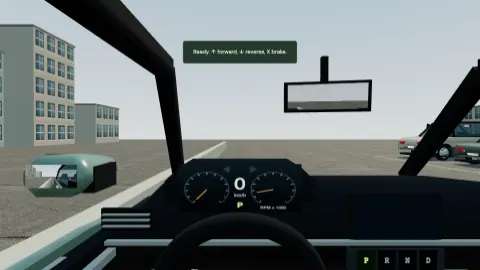
Forward and perpendicular parking practice
Driving into a perpendicular bay can look simple until the aisle narrows. This exercise shows how the front enters, how the rear follows a different path, and why arriving between the lines does not always mean the car is straight.
Plan for the rear as well as the nose
Identify the target bay, the cars on either side and the opposite aisle wall. The front wheels steer into the space, but the rear wheels follow a tighter inside path. If you aim only at the center of the bay with the front bumper, the inside side of the body can still approach the neighboring car. Use Geometry to observe the full footprint before trying the maneuver from Cockpit. The marked space describes the destination, not a safe corridor for every possible entry.
A controlled forward bay approach
Watch the demonstration and pause before entry, during the turn and as the car begins to align. On your attempt, move slowly enough to compare both sides of the bay. Leave room for the turn instead of hugging the inside neighboring vehicle. Begin straightening as the body approaches the direction of the bay, then check whether there is enough length to complete the alignment. If the angle is poor, stop, look around the simulated vehicle and reverse carefully to reposition. Do not keep moving forward simply because the bumper is already between the lines.
Observe the inside rear path
During a forward turn, the front corner and rear wheel do different things. The inside rear wheel can approach a line or obstacle even after the front has passed it. Compare Cockpit with Geometry at that moment to understand what the side mirror is showing. Check the opposite front corner too, especially when correcting beside the aisle wall. A reversing correction changes which corners are closest; the previous safe direction does not establish clearance for the new movement.
Fix an entry that finishes diagonally
A diagonal finish often begins with an approach that offers too little turning room or a turn held too long. Replay the maneuver from above and find when the car first points along the bay. Compare that with the moment you straightened the wheel. Straight steering while the body is angled continues the angled path. Try an earlier reduction in steering or use a deliberate reversing correction. Work on one adjustment at a time, keeping the difficulty unchanged so you can compare the result.
Why difficulty changes the maneuver
As you raise the level, the bay and aisle become smaller. A comfortable continuous entry may turn into a multi-movement approach. The demonstration executes the current setup; it is an example of a verified route, not a guarantee that a memorized starting marker works in every layout. Compare the tighter exercise with Reverse Bay Parking to see where each approach needs clearance. Angled Parking is another distinct case because its target is not perpendicular to the aisle.
Finish and review the whole vehicle
Look for a straight, contained final position with clearance, then stop and secure the car with P and the parking brake. Use Finish & review to inspect contacts and your replay. This exercise requires Full Access; the reverse bay exercise is one of the five free scenarios if you want to start there. All simulator views are available for learning, but real observation also includes blind spots and moving road users that ParkLab does not simulate. Follow local instruction when practicing in a real car.
Related practice: Reverse Bay Parking · Angled Parking · Front Corner Clearance.
Read the mirror and reference-point guide or practice corrections in tight spaces.
Exercise notes by the ParkLab team · Reviewed . ParkLab is a generic simulated vehicle, not a driving certification.