 PARKLAB
Angled Parking
Turn from the aisle into a metric bay at 30°, 45°, or 60°.
Observe, then move.
Approach along the aisle, check both front corners, and turn into the bay at walking pace. The rear wheels cut inside your front-wheel path. Straighten when the lines run parallel in the mirrors.
What to observe
The two bay lines should run parallel to the car in the mirrors, regardless of their angle to the aisle.
In Physical driving, secure your stopped finish with P and the parking brake. Use Shift+B or the Parking brake button in Options.
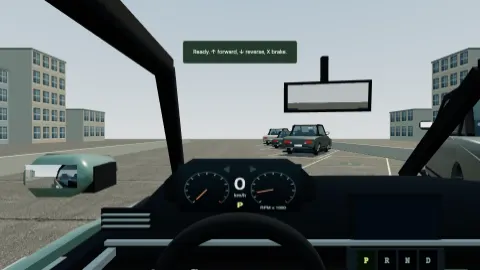
Practice angled parking and understand the turning room
An angled bay points along a different direction from a perpendicular space. ParkLab lets you study the entry, the neighboring vehicles and the opposite wall, then compare the maneuver with reversing out of the same kind of bay.
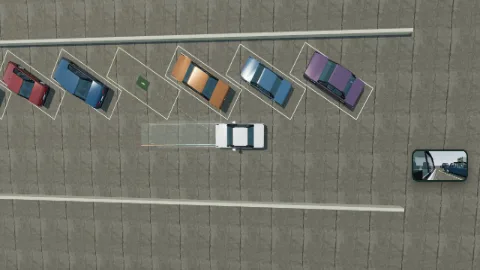
Look at the angle, not just the parking lines
Identify where the bay mouth meets the aisle and how the target points away from it. At a shallow angle, the car can approach along a gentler arc than a perpendicular bay. That does not make the whole vehicle clear: the rear, mirrors and front corners still need room. The aisle wall constrains repositioning even when the target itself is long enough. Use the overhead view to compare the available lane with the width and length of the white car.
Practice a deliberate forward entry
Watch the demonstration before driving. Pause when steering begins and notice the direction the car is approaching from. In your attempt, use a slow forward movement that brings the body toward the bay’s direction. Observe the inside side as the rear follows the front into the space. Reduce steering as the car aligns with the two lines rather than assuming that entering the mouth means you are already straight. If the entry leaves a poor angle, stop before attempting a short correction.
Understand the opposite-wall constraint
The opposite wall matters when the front swing or a reversing correction uses the aisle. ParkLab’s angled layouts use angle-aware aisle widths: a shallow bay does not receive the same turning allowance as a perpendicular one. Higher levels bring the wall closer and reduce the target width. In the supplied 30-degree Extreme setup, the clear aisle is 2.8 metres, measured from the painted mouth to the wall face. This is a description of that simulation setup, not a recommended minimum aisle for real parking design or a promise that your own approach will fit.
Recognize two different clearance problems
Contact on entry can involve the inside rear corner cutting toward a neighboring car. Contact during correction can instead involve a front corner swinging toward the aisle wall. The closest obstacle changes as you change direction. Pause your replay before the gap becomes critical and identify the moving part of the body. Compare the visible mirror picture with the Geometry view. Checking only the center of the front bumper can miss both of these problems.
Study reversing out separately
A safe parked pose is the beginning of another maneuver, not proof that the departure is clear. Reverse Out of an Angled Bay provides a separate exercise for observing the aisle during exit. The steering direction, front swing and point at which the body leaves the neighboring vehicles matter there too. Compare entry and exit using the same views, but do not assume you can steer in the aisle as soon as the rear bumper crosses a painted line. The complete car still needs clearance.
Use the levels without chasing the smallest gap
Start on Beginner to learn the relationship between approach and target angle. Advance when you can repeat a controlled finish with room around the car. The narrower levels deliberately reduce your correction space; they are useful for studying why a generous approach no longer works. Full Access is required for this exercise, while reverse and parallel parking are available free. The model is generic and the scene has stationary obstacles, so use the lesson for geometric understanding rather than as driving certification.
Related practice: Reverse Out of an Angled Bay · Forward Bay Parking · Reverse Bay Parking.
Read the mirror and reference-point guide or practice corrections in tight spaces.
Exercise notes by the ParkLab team · Reviewed . ParkLab is a generic simulated vehicle, not a driving certification.