
Parking mirrors and reference points
A useful reference point connects something you can see with a movement you understand. It becomes unreliable when you treat the picture as a fixed instruction without checking the rest of the car. Use ParkLab to compare the driver’s view with the geometry that creates it.
Try the free exercise →No account needed · Five free scenarios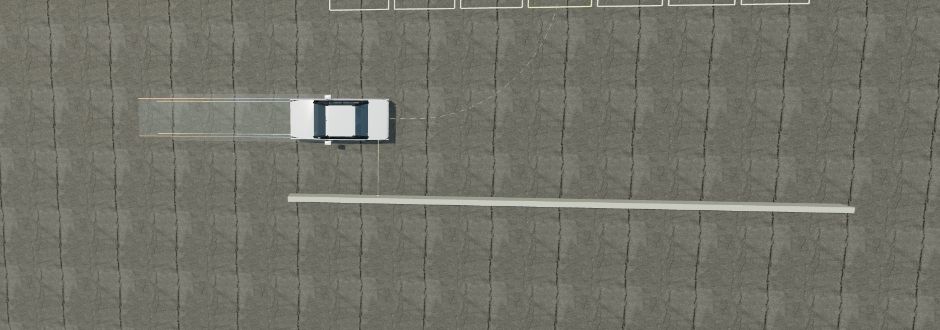
A deliberate practice routine
Start with the driver’s picture
Open free Reverse Bay Parking on Beginner and select Cockpit. Before moving, find the two side mirrors and the rear-view mirror. Identify which bay lines, neighboring vehicles and parts of your own car appear in them. Switch to Geometry to see the same objects from above. This first comparison tells you what a mirror can show and what lies outside its view. Do not begin by choosing a turning marker: begin by understanding the scene you are observing.
A line’s angle and a line’s distance are different clues
As the car reverses toward a bay, the painted lines change direction and position in the mirrors. Their direction helps you judge the body’s alignment with the space. Their apparent spacing also changes with the viewpoint, mirror aim and angle of approach. Equal-looking gaps in two different mirrors are therefore not a direct measurement of equal physical clearances. Stop and compare the overhead view when the picture is confusing. Return to Cockpit and identify the clue that changed, so the next observation is based on a relationship rather than a remembered screenshot.
Observe front swing while watching the rear
In a reversing turn, the rear moves toward the parking space while a front corner can move toward an obstacle in the aisle. Follow the demo from the driver’s seat, then replay it from Geometry and pause as the body rotates. Look at the outside front corner separately from the rear-wheel path. The rear camera explains the area behind the car; it cannot prove that this front corner is clear. Your next attempt should include that missing observation, even if the rear view looks comfortable.
Test a reference point instead of assuming it transfers
Choose a specific visual event in a comfortable attempt, such as a bay line reaching a familiar location in a mirror. Pause and record what the car is actually doing at that moment: its body angle, distance from the neighboring car and available correction space. On a later attempt, compare those physical relationships before repeating the action. If the approach or difficulty has changed, the same screen event may occur with different room available. A real vehicle’s length, seat position, mirrors and steering also alter the picture; ParkLab does not provide calibrated universal markers for those vehicles.
Understand width cues and sensors
The L and R cues show a forward mirror-inclusive width reference with an added allowance. They remain visible while reversing or steering, but they are not a certificate of a turning path. A sensor gap likewise reports nearby geometry rather than the safety of your next steering movement. In the free narrow entrance exercise, compare the opening with the car’s mirrors from Geometry, then observe it from Cockpit. This separates a useful aid from a decision that still requires checking the actual envelope and angle.
A five-minute observation practice
Watch the reverse bay demonstration once, then make one slow attempt with the goal of noticing the outside front swing. Stop, choose P and engage the parking brake before reviewing. Pause your replay at the point that felt least clear and compare two views. Repeat the attempt, this time observing the alignment of the bay lines. Keep the level unchanged so you can compare your attention rather than two different layouts. Increase difficulty after controlled finishes become repeatable, not simply after one lucky attempt.
When to use another view
Geometry and Outside are learning tools: they make a corner or hidden side easier to understand. After using them to diagnose a mistake, return to Cockpit and work out which available observation could help you notice the same problem. A mirror-only exercise gives you another way to concentrate on that task, while the free parallel parking exercise lets you study the curbside view. ParkLab has stationary obstacles and generic vehicle response. Real driving also requires observation of blind spots, pedestrians and moving traffic, with suitable instruction. The RAC and AA references linked from the introduction guide are further reading, not verification of ParkLab’s reference markers.
Continue with the introduction to parking practice, reverse bay parking, parallel parking or corrections in tight spaces.
Written for ParkLab’s actual simulator by the ParkLab team. Reviewed . No universal real-car reference points or driving-test outcome are claimed.