 PARKLAB
Parallel Parking · Right
A generous curbside space. Learn the arc, the front swing, and the final alignment.
Observe, then move.
Stop beside the front car about 0.5–1 m away, rear bumpers level. Reverse slowly and turn full lock toward the curb. When the curb or bay line reaches the lower inner corner of the curbside mirror, stop, turn full lock the other way and keep reversing until the car is straight. If the rear gets close first, stop and finish forward with full lock toward the curb.
What to observe
Keep the small curbside mirror in view the whole time: first the car behind the gap, then the curb line sliding into its lower inner corner. Check the outer front corner before countersteering.
In Physical driving, secure your stopped finish with P and the parking brake. Use Shift+B or the Parking brake button in Options.
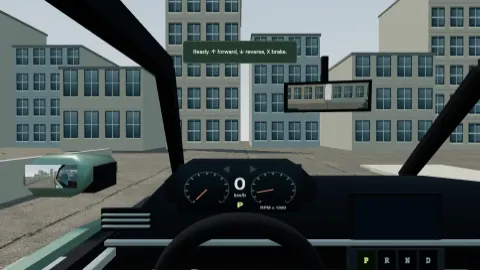
Learn parallel parking between two cars
A curbside gap asks you to manage two movements at once: the rear of your car enters the space while the front swings into the lane. This free ParkLab exercise lets you pause that movement, inspect both ends and try again without memorizing one steering sequence.
Understand the space before reversing
Start on Beginner and identify the front neighboring car, rear neighboring car and roadside curb. The marked target shows where the complete car should finish; it is not a promise that every approach will fit. Look at the lane beside the gap as well as the gap itself. A parked car can fit between two bumpers while still needing more room to turn into that space. Use Geometry to see this distinction, then return to the cockpit and compare the same scene in your side mirrors.
A parallel parking practice sequence
Watch the demonstration once from Cockpit and once from Geometry. Pause before the rear starts entering the gap and notice the starting position alongside the front car. On your own attempt, reverse slowly into the space while checking the inside rear corner and the opposite front corner. As the rear enters, reduce the angle and bring the front into line with the curb. If either end is running out of room, stop before changing direction. Use a short forward correction rather than continuing an arc that is taking the body toward another car.
Where to look in the mirrors
The curbside mirror helps you observe the car’s angle to the curb and the path of its rear corner. The opposite mirror and a direct view help explain the front swing. The rear camera is another view of the space behind; it cannot tell you that the opposite front corner is clear. Compare the two sides after straightening, then check front and rear room separately. ParkLab’s reference markers support observation, but a mark on the screen is not a universal turning point for another car or seat position.
Why a parallel parking attempt goes wrong
Turning too early can put the rear corner into the front neighboring car. Holding the turn too long can take the rear toward the curb, while late countersteering leaves the front at an awkward angle. Another common mistake is watching only the rear because the car is reversing. Use your replay to find the first moment the clearance begins shrinking, not just the final contact. Change one thing on the next attempt: the approach, the distance moved before steering, or the point at which you stop for a correction.
Progress from a generous gap to a confined one
The five levels reduce the space available. Complete several slow attempts with clearance before choosing a smaller gap. Tight Parallel Parking provides a shorter target than the ordinary exercise; the opposite-wall variant also constrains the lane used by the front swing. They are different problems, so a technique that succeeds in the open lane may need more corrections beside a wall. Practice the left-side version to understand the mirrored movement instead of treating right and left as two unrelated recipes.
Know what this simulator can teach
Use the arrow keys for movement and steering, X to brake, and stop before changing direction. On a phone, rotate to landscape and use the touch controls. When finished, stop, choose P and engage the parking brake before reviewing. This is practice in a generic simulated vehicle, with stationary obstacles and no moving traffic. It does not certify a driving-test result or replace supervised lessons. For road-specific guidance, consult your instructor and local rules; the RAC parallel parking guide linked below is written for the UK.
Further reading: RAC parallel parking guide (UK).
Related practice: Parallel Parking · Left · Tight Parallel Parking · Right Parallel Parking · Opposite Wall.
Read the mirror and reference-point guide or practice corrections in tight spaces.
Exercise notes by the ParkLab team · Reviewed . ParkLab is a generic simulated vehicle, not a driving certification.