
Parking in a tight space: make room for corrections
A tight space creates two questions: can the car finish inside it, and can the complete vehicle reach that position from your approach? Those questions have different answers. Learn to inspect both before reducing a parking maneuver to smaller and smaller movements.
Try the free exercise →No account needed · Five free scenarios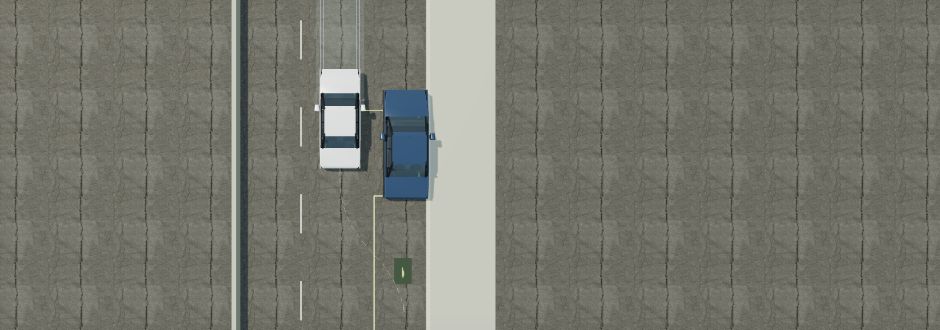
A deliberate practice routine
Distinguish the target from the approach
In free Parallel Parking, the target lies between a front and rear parked car. Geometry shows the gap length and the aisle beside it. A longer gap gives room to change the car’s angle while the front uses space outside the target. The wall-constrained parallel exercise adds a second limit: the lane used by that swing. A gap that contains the final parked body can still demand several direction changes to reach. Inspect the available room before treating a small target as the whole difficulty.
Choose the corner to watch before moving
Before a correction, identify which corner is moving toward which obstacle. During reverse entry, that might be the inside rear corner beside the front neighboring car; later it might be the front beside the opposite wall. Steering changes the paths of the whole body, not just the direction of a center point. Pause a demonstration and compare the car’s current orientation with the next movement. This makes the observation specific: you are checking the part that will lose clearance first, rather than scanning without a purpose.
A short correction needs a clear purpose
Brake to a stop before changing direction. Decide whether the next movement creates lateral room, reduces the body angle or shifts the car along the bay. Move slowly, then check whether it achieved that purpose. If the same corner approaches the same obstacle again, another identical movement is unlikely to fix the problem. Review the approach or use a different steering phase while there is room. Tiny movements are useful when each creates a measurable improvement; their size alone does not make them appropriate.
Compare an open lane and an opposite wall
Begin with ordinary parallel parking at a comfortable level, then compare Tight Parallel Parking and the opposite-wall variants. The tight version has a shorter bay; the confined version also restricts the lane. These are separate constraints, so do not assume the approach from the open lane will work unchanged beside a wall. In the current stock Extreme tight-confined layout, the added target length is more generous than in the open tight exercise because both restrictions must still allow a physically verified route. That is a deliberate simulation tradeoff, not a real-car minimum gap recommendation.
Use replay to find the first lost opportunity
If a movement ends in contact, review a frame before the gap became critical. Look for a point where stopping or changing the approach would have left more room. An attempt can be difficult to recover because an earlier movement used the available space, not because the last steering input was wrong. Compare the rear-wheel path and outside front corner, then repeat at the same level with one adjustment. Use measured contacts and clearance to test your explanation rather than treating eventual completion as proof of a controlled maneuver.
Transfer the idea to bays and garages
A narrow reverse bay can require a forward correction before the final reverse. A pillar introduces a local restriction even when there is space elsewhere in the aisle. The angled parking exit changes which ends approach neighboring cars as the car leaves its target. These exercises share the idea of inspecting the envelope, but they do not share one universal sequence of steering turns. Use the matching demonstration to study each situation. Several of these exercises require Full Access; the free bay and parallel exercises provide the starting practice.
Finish with room, then choose the next challenge
A useful finish is contained, stopped and clear, with P and the parking brake securing the car. Check both ends and sides rather than chasing a minimum sensor reading. Increase difficulty after you can reproduce that result, then notice which constraint changed. On mobile, rotate to landscape so the touch controls and mirrors remain visible. This simulator does not include moving traffic or validate every real vehicle’s response. If an actual space leaves uncertain clearance or unsafe surroundings, stop and reassess with appropriate real-world instruction.
Continue with the introduction to parking practice, reverse bay parking, parallel parking or mirrors and reference points.
Written for ParkLab’s actual simulator by the ParkLab team. Reviewed . No universal real-car reference points or driving-test outcome are claimed.