 PARKLAB
Three-Point Turn
Turn around on a street bounded by concrete walls.
Observe, then move.
Turn fully while moving slowly, stop before contact, reverse with opposite steering, then finish forward. Additional corrections are preferable to contact.
What to observe
Before reversing, check the rear and both sides. Before moving forward, check the new outside front corner.
In Physical driving, secure your stopped finish with P and the parking brake. Use Shift+B or the Parking brake button in Options.
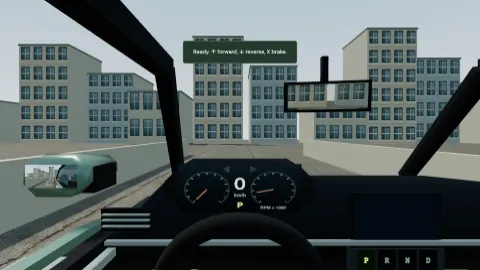
Practice a three-point turn in a narrow street
When there is not enough width for one continuous turn, direction changes create another way to reposition the car. This free exercise lets you study the front and rear corners beside two walls, then review each forward and reversing movement.
Check the available street width
Identify both street walls and the direction of the final target. The target shows the completed turn, but the important room is the space used by the whole car between the walls. In Geometry, look at the front overhang and rear corners, not just the wheel tracks. A front wheel clearing an edge does not mean the bumper or mirror clears it. Start on Beginner so you can see the movement before trying a smaller wall-to-wall width.
Understand each direction change
Watch the demonstration and pause at every stop. Notice which side the front approaches during the forward movement and which side the rear approaches during reverse. On your own attempt, make a controlled forward turn until another movement is needed, brake to a stop and observe the car’s angle. Reverse with steering that helps reorient the body while checking the rear and opposite front corner. Stop again before the next forward movement. The aim is to create a better orientation and enough clearance, not to keep the car moving continuously.
Three points is a maneuver name, not a universal limit
A particularly narrow space can require additional short corrections. ParkLab’s higher levels reduce the street width, so a route that needs a few movements on Beginner may require more on Extreme. Do not force the third movement to finish if it approaches a wall. Instead, compare the body angle and remaining room, then use another safe correction. The demonstration is an example of a verified maneuver in the current setup, not a claim that every approach fits into a fixed number of turns.
Observe both ends during reverse
A frequent mistake is switching all attention to the rear after selecting reverse. The front still swings as the body rotates and can approach the wall it appeared to be leaving. Compare Cockpit, rear camera and Geometry while learning to see that relationship. Before each new movement, identify which corner will get closer to a wall first. The nearest-gap measurement is useful feedback, but understanding why the gap changes makes the next correction more deliberate.
Review contact instead of repeating it
If the maneuver touches a wall, pause the replay before the contact frame. Check whether the first movement used too much street width, whether the reversing angle was poor, or whether steering changed too late. Repeat at the same level and adjust one choice. A shorter movement can leave more correction room; a different starting angle can also change the available path. Avoid advancing difficulty merely because one attempt eventually reached the target after repeated contacts.
Carry the observation skill into other exercises
Escape From Tight Parking asks you to reposition from a confined parked pose; narrow entrances and wall-constrained parallel parking use related corner observations in different layouts. The three-point exercise is free without an account and provides six views plus replay. Stop, select P and engage the parking brake for a secure final state. A real turn also involves road legality, visibility, pedestrians and moving traffic that ParkLab does not simulate. Use suitable instruction and local rules for an actual road maneuver.
Related practice: Escape From Tight Parking · Tight Garage Entrance · Right Parallel Parking · Opposite Wall.
Read the mirror and reference-point guide or practice corrections in tight spaces.
Exercise notes by the ParkLab team · Reviewed . ParkLab is a generic simulated vehicle, not a driving certification.