 PARKLAB
Tight Garage Entrance
Enter a narrow opening with the full vehicle envelope.
Observe, then move.
Straighten before the door. Front-wheel clearance alone is insufficient: the mirror housing is farther out.
What to observe
Compare the door frame with both mirrors. Avoid steering until the rear of the car has cleared the opening.
In Physical driving, secure your stopped finish with P and the parking brake. Use Shift+B or the Parking brake button in Options.
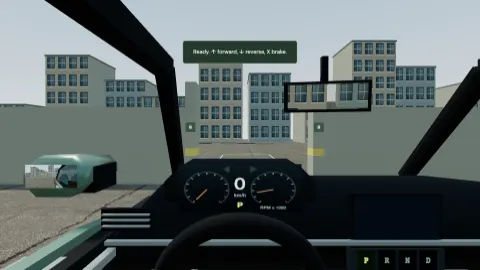
Judge car width through a narrow garage entrance
This free exercise separates straight-line width judgment from turning into a parking bay. Drive the car and its mirrors through a constrained opening, observe both sides and learn why a centered view is not the same as measured clearance.
Include the mirrors in the width
Look at the two posts and the white player car from Geometry before moving. The body width is only part of the envelope: the mirrors protrude on both sides. A gap that appears wider than the cabin may still be too narrow for the complete car. The exercise opening is generated relative to the supplied vehicle’s mirror span, and the higher levels reduce the added allowance. Those dimensions describe this simulation; they are not a guarantee for a real vehicle with different mirror mounts or folded mirrors.
Align before entering the opening
Start on Beginner and watch the demonstration. Compare the car’s direction with the entrance, then make a slow approach from Cockpit. Avoid waiting until you are between the posts to make a large steering correction. An angled body uses more lateral space than the same body aligned with the opening. If the approach is poor, stop before the posts, observe both sides and reposition. Moving a few centimetres at a time can be useful when the observation changes; moving blindly in tiny steps does not make a bad angle safe.
Use the width references for what they show
The L and R HUD cues represent mirror-inclusive forward width with an additional safety allowance at a point ahead of the car. They remain visible during steering and reverse, but they do not certify a curved path or a particular opening. Treat them as an aid to understanding the forward envelope, then check the posts, the actual mirror positions and the changing angle. A front reference passing a post does not establish that the rest of the car has passed it.
Why steering can create a new contact
When you steer, the corners and mirrors move along different arcs. A correction that moves the front away from one post can take another part of the body toward the opposite post. Pause the replay during the correction and inspect that movement from above. Compare the result with the cockpit picture to understand which side was obscured. Do not assume that the steering direction alone tells you which part of the car is moving away from an obstacle.
Compare straight entry and reverse passage
Repeat the same entrance at a comfortable level until you can maintain a controlled alignment. The Reverse Through a Gate exercise studies the opposite movement and its different observations. Extreme Precision Challenge reduces the mirror allowance further than the ordinary entrance at the same level. These narrower cases are for deliberate observation, not a target for squeezing a real vehicle through uncertain gaps. If you cannot establish clearance, the appropriate real-world action is to stop and assess the opening.
A useful width-judgment practice loop
Choose one observation before each attempt: alignment with the posts, the mirror on the near side, or the opposite corner during correction. Make your attempt, use Finish & review, and compare the replay with your expectation. The free exercise requires no account; an account saves your progress across devices. Use landscape on mobile and full screen where supported. ParkLab has stationary obstacles and a generic vehicle response; it supports understanding but cannot replace observation of actual traffic, pedestrians or your own car.
Related practice: Reverse Through a Gate · Extreme Precision Challenge · Narrow Underground Garage.
Read the mirror and reference-point guide or practice corrections in tight spaces.
Exercise notes by the ParkLab team · Reviewed . ParkLab is a generic simulated vehicle, not a driving certification.